.svg)

.png)

Blog
The Diet Wars Are Missing the Point: Why Your Body Doesn't Care About Your Ideology

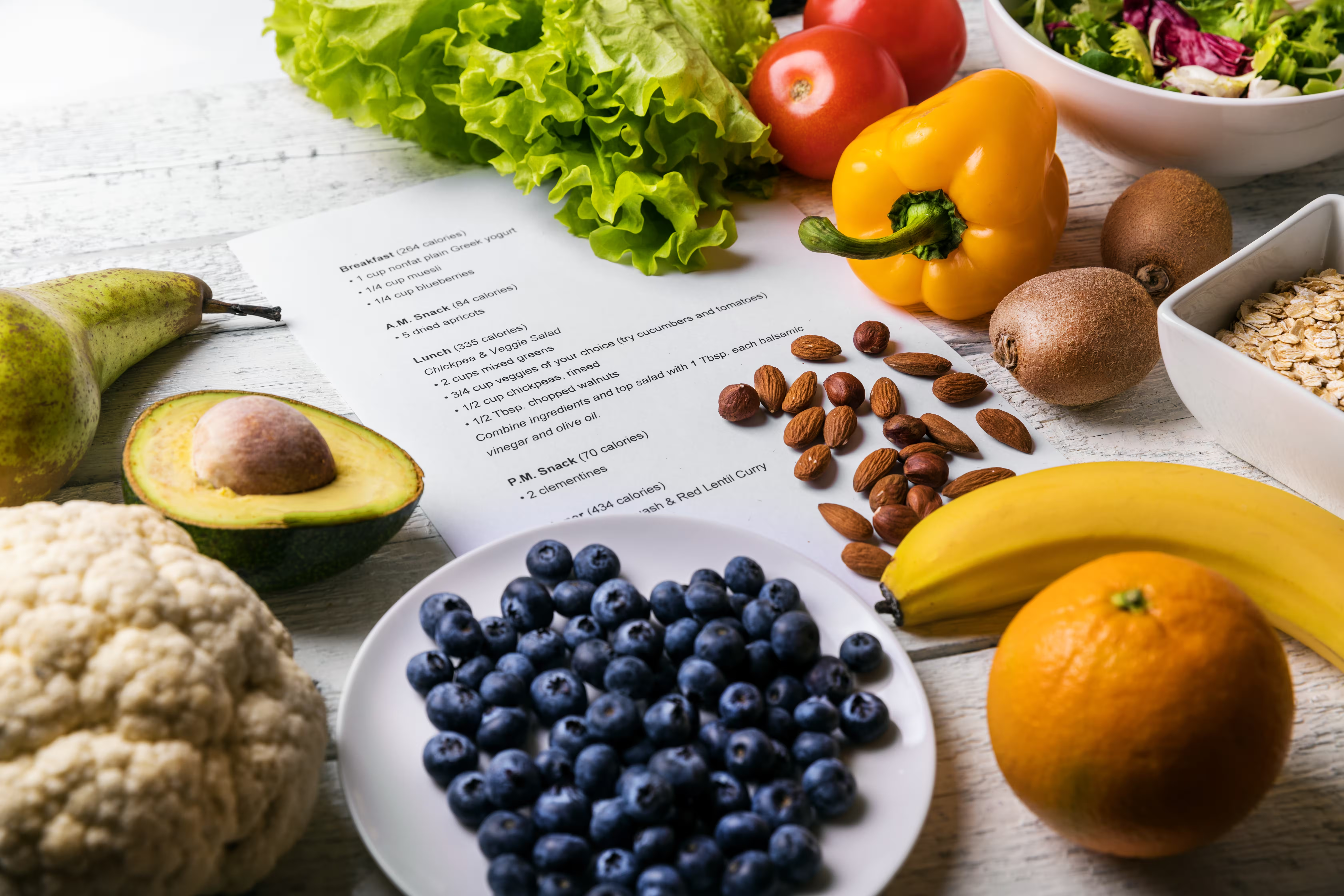
If you've spent the last five years bouncing between carnivore, keto, vegan, and every diet in between, only to end up more confused than when you started, you're not alone.
In a recent episode of Homes on Health, Dr. Allen Holmes tackles one of the most frustrating myths in modern nutrition: that there's one "perfect" diet everyone should follow. Spoiler alert: there isn't. And while the internet has turned nutrition into a battlefield, the real science tells a completely different story.
This conversation is about cutting through the noise and giving you a framework that actually works, no matter which camp you've been loyal to.
The Patient Who Tried 17 Diets (And Failed Every Time)
Dr. Holmes starts with a story that might sound painfully familiar: a patient who tried 17 different diets in just five years. Carnivore. Keto. Vegan. Mediterranean. Intermittent fasting. You name it, he tried it.
And here's the kicker: he lost weight on every single one of them. But he also gained it all back. Every. Single. Time.
By the end, he wasn't just frustrated—he was completely confused about what actually works. Sound familiar?
Why Both a Carnivore Dieter and a Vegan Can Thrive
Dr. Holmes shares two patient stories that flip conventional wisdom on its head:
Sarah, 35, lost 40 pounds eating nothing but beef, eggs, and salmon. Her inflammation dropped, her energy soared, and she looks phenomenal.
David, 42, lost 35 pounds on a completely plant-based diet. His cholesterol plummeted, his blood pressure normalized, and he's running half marathons.
According to the internet, one of these people should be dying. Sarah's arteries should be clogged. David should be wasting away from protein deficiency.
But they're both thriving.
How is that possible?
While carnivore advocates and plant-based evangelists throw studies at each other like grenades, they're missing three fundamental principles that govern human metabolism. Once you understand these principles, you can make almost any diet work.
The Truth About Carnivore
Critics say the carnivore diet is unsustainable, lacks nutrients, and will cause long-term health problems. And they're probably not entirely wrong.
But here's what they miss: for people dealing with autoimmune issues, severe insulin resistance, or food sensitivities, the carnivore diet can act like a metabolic reset button. It eliminates virtually all dietary triggers while providing complete proteins and bioavailable nutrients.
The real reason carnivore works for weight loss? It creates a massive calorie deficit and eliminates processed foods. When you cut out an entire macronutrient group like carbs, you're eliminating a huge number of calories. Plus, fats and protein are more satiating, so you simply don't need to eat as much or as often to feel full.
The Truth About Plant-Based Diets
The research on properly planned plant-based diets is compelling: lower disease rates, potential longevity benefits, and yes, possible environmental advantages.
But here's where it gets interesting: the magic isn't necessarily in avoiding animal products. The magic comes from what people start eating when they go vegan: more vegetables, more fiber, more micronutrients, fewer processed foods.
The catch? Maintaining muscle mass on a plant-based diet requires significant strategic planning. Most plant proteins are incomplete, lacking essential amino acids like leucine, which is crucial for muscle synthesis. This becomes especially important as we age.
The Truth About Keto
Keto promises to turn you into a fat-burning machine. And for many people, it actually delivers.
But here's the dirty secret: keto works primarily through appetite suppression. High-fat foods and protein are simply more satiating. That dramatic initial weight loss? It's mostly water weight, not some magical metabolic advantage.
When you drastically reduce carbs, you lose glycogen, and glycogen holds water like a sponge. Less glycogen equals less water, which leads to impressive early results on the scale.
The real benefits of keto are stabilizing blood sugar and reducing hunger. If you're insulin resistant, pre-diabetic, or constantly snacking because you're always hungry, keto might be an excellent choice.
The downside? If you love high-intensity exercise, keto can make it really hard to perform, at least early on.
The Truth About Macro Counting
This is the diet of bodybuilders and Instagram fitness influencers. The positive? It's the most flexible approach because it's based on the fundamental truth that calories and macronutrients matter more than food sources.
You can eat anything—carbs, fat, protein—as long as it fits your macros. Theoretically, you could even work Pop-Tarts into your diet and still reach your goals.
But the catch? It turns eating into a constant math problem. You're always calculating, measuring, tracking. And unless you're carrying a food scale everywhere, accuracy becomes a real issue. How do you measure that Chipotle bowl? How accurate is that Google calorie count?
For many people, this creates an unhealthy obsession with numbers rather than focusing on hunger cues and food quality.
The Three Pillars That Actually Matter
After demolishing the myths, Dr. Holmes reveals the three principles that govern every successful diet:
Pillar 1: Energy Balance
Here's the truth every diet guru tries to complicate: you cannot escape the law of thermodynamics.
Whether you're carnivore, vegan, or eating nothing but pizza, if you consume more energy than you expend, you will gain weight. If you consume less, you will lose weight.
But here's where it gets sophisticated: not all calories affect the body the same way. Protein requires more energy to process than carbs or fat. This is called the thermic effect of food.
Example: 100 calories of chicken might require 20 calories to process, netting you only 80 calories. But 100 calories of rice might only require 5 calories to process, netting you 95 calories. Over time, that adds up significantly.
The practical application: Regardless of which diet you choose, you need to be in a caloric deficit to lose fat. The diet that helps you maintain that deficit most easily is the right diet for you.
Pillar 2: Protein
This is where most diets fail catastrophically.
When you're in a caloric deficit, your body is at risk of losing muscle mass. The only way to prevent this is adequate protein intake combined with resistance training.
How much is adequate? We're talking 0.8 to 1 gram per pound of body weight daily. For a 150-pound person, that's roughly 120-150 grams of protein per day.
Why does this matter so much? Think of muscle tissue as metabolically active. For every pound of muscle you preserve, it burns calories just by existing.
Dr. Holmes uses a powerful analogy: think of your muscle mass like a furnace. The larger the furnace and the hotter it burns, the more fuel you burn. Lose muscle while dieting, and you're tanking your metabolism. Preserve the muscle, and you preserve your metabolism, allowing you to eat more calories at your goal weight while maintaining your results.
This is why protein-centric diets like carnivore often work so well for body composition, while vegan dieters need to be extremely strategic about hitting protein targets.
Dr. Holmes is crystal clear: "It isn't about just losing the weight. There are a hundred different ways to lose 30 pounds. I could sew your mouth shut and you'd lose weight. I could cut off a limb and the scale would read less. How you lose the weight is super important."
That's why his clinic focuses on fat loss, not weight loss. The goal is to lose fat and maintain or even gain muscle because helping someone lose 40 pounds only to gain it all back because their metabolism tanked? That's failure.
Pillar 3: Sustainability
The best diet is the one you can follow for years, not just weeks.
This is where most people go catastrophically wrong. They choose a diet based on dramatic before-and-after photos they saw on Instagram rather than long-term adherence.
Ask yourself: Can you imagine eating only meat for the next five years? Can you imagine never eating cheese again? Can you imagine weighing every single morsel of food for the rest of your life?
The answers to those questions should guide your dietary choices more than any social media transformation post.
Your Prescription: A Framework, Not Another Diet
Dr. Holmes offers a practical framework:
1. Choose an approach that naturally puts you in a calorie deficit without making you miserable.
● Love meat and hate counting? Try carnivore or low-carb.
● Love variety and flexibility? Try macro counting.
● Have ethical concerns about animal products? Go plant-based—but prioritize protein.
2. Hit your protein target every day. This is non-negotiable if you want to preserve muscle and maintain your metabolism. Carnivore, keto, vegetarian—doesn't matter. Hit your protein.
3. Plan for the long term. Ask yourself: Can I see myself eating this way in two years? If the answer is no, keep looking.
4. Track your biomarkers. Not just weight: track energy levels, sleep quality, workout performance, and mood. Do lab work before you start. Are you insulin resistant? Where are your cholesterol levels? Your inflammatory markers? This helps guide the right choices and lets you track real progress over time.
The Bottom Line: Stop Looking for Magic
The diet wars are a distraction. While people argue about whether humans are meant to eat meat or plants, you can get real results by focusing on what actually matters: energy balance, protein adequacy, and long-term sustainability.
The perfect diet doesn't exist. But the perfect diet for you does exist.
It's the one that helps you maintain a calorie deficit, hit your protein goals, and stick with it long enough to see—and maintain—real results.
So stop looking for the magic formula. Start looking for what works for you. Get Expert Guidance at BioSymmetry Wilmington
At BioSymmetry Wilmington, our team specializes in personalized nutrition and hormone optimization strategies that work with your unique metabolism—not against it.
Whether you're trying to navigate conflicting diet advice, struggling to maintain your results, or simply want a science-based approach that fits your lifestyle, we're here to help you find what actually works for your body.
Watch the full episode of Homes on Health on YouTube to hear Dr. Holmes break down the science in more detail.
Disclaimer: This blog is for general informational purposes only and does not constitute the practice of medicine, nursing, or other professional health care services, including the giving of medical advice, and no doctor/patient relationship is formed. The use of the information on this blog or material linked from this blog is at the user's own risk. The content of this blog is not intended to be a substitute for professional medical advice, diagnosis, or treatment. Users should not disregard, or delay in obtaining, medical advice for any medical condition they may have, and should seek the assistance of their health care professionals for any such conditions.
Read More Blogs!
Stay updated with the latest blog posts and engage with our community.
At Biosymmetry Wilmington we provide advanced services for women and men in aesthetics, wellness and hormone therapy. Our personalized treatments are built to restore balance, boost vitality, and enhance natural beauty. Whether you are seeking weight management, antiaging solutions, or overall wellness our team is here to guide you every step of the way. Start today and experience patient focused care that helps you look and feel your best.